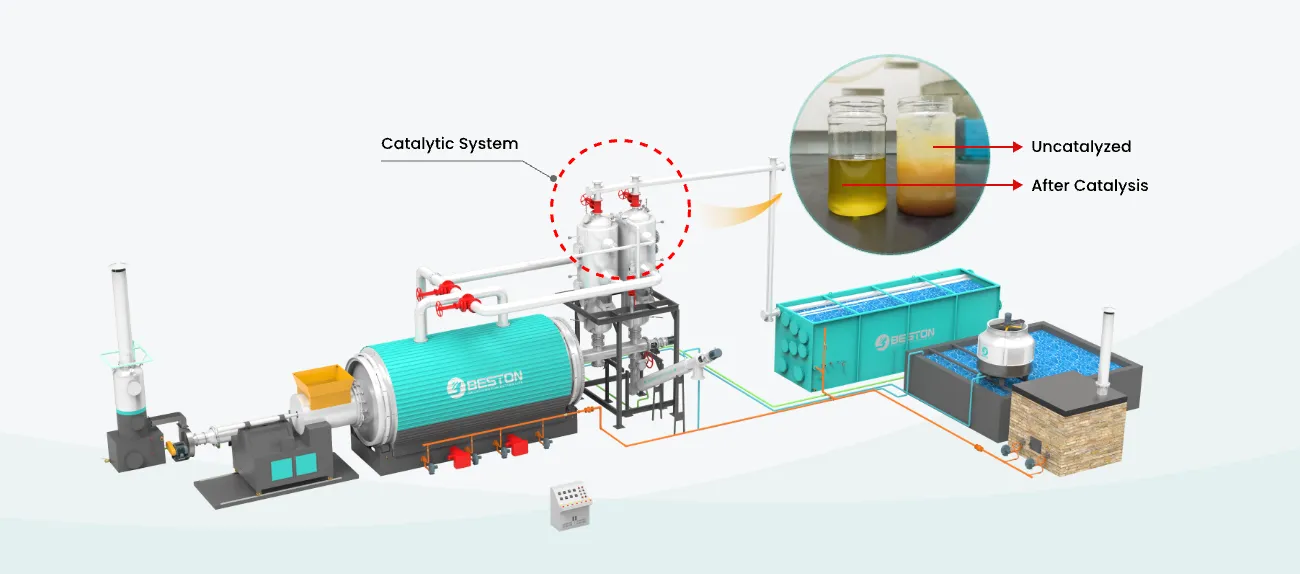
Waste management strategies generally focus on two objectives: recovering usable materials and extracting energy from residual waste. Material recovery prioritizes resource conservation by returning recyclable materials to manufacturing cycles, while waste-to-energy (WtE) technologies convert non-recyclable waste into usable energy. Pyrolysis occupies an intermediate position. It transforms selected waste streams into secondary products, including pyrolysis oil, combustible gas, and solid carbon residues.
Understanding where pyrolysis fits requires examining feedstock characteristics, resource recovery potential, environmental considerations, and the intended use of the resulting products.
1. Waste-to-Energy and Material Recovery: Different Priorities
Material recovery aims to preserve the intrinsic value of discarded resources. Mechanical recycling, for example, separates, cleans, and processes materials such as paper, metals, glass, and certain plastics for reuse. Its principal advantage is that recovered materials can replace virgin raw materials, reducing demand for additional extraction and processing.
Waste-to-energy follows a different pathway. Incineration, gasification, and other thermal conversion processes reduce waste volume while generating heat, electricity, or combustible products. These technologies are particularly relevant to residual waste that cannot be practically recycled through conventional methods.
Neither approach is universally suitable for every waste stream. Material recovery generally takes priority when materials can be recycled effectively. Thermal conversion becomes a potential option for fractions that are unsuitable for established recycling routes.
2. Where Does Pyrolysis Technology Fit?
Pyrolysis is a thermochemical conversion process that decomposes organic materials under oxygen-limited or oxygen-free conditions. Unlike conventional incineration, it does not rely on direct combustion of the feedstock within the reactor.
A pyrolysis plant can process selected waste materials, including waste plastics, used tires, and certain biomass residues. Depending on feedstock composition and operating conditions, the process produces liquid oil, non-condensable gas, and solid carbonaceous materials.
Its position between material recovery and energy recovery is particularly important. Pyrolysis does not simply destroy waste to generate heat. Instead, it converts suitable feedstocks into secondary resources that may have further industrial applications.
For example, a plastic pyrolysis plant can process eligible polyethylene (PE), polypropylene (PP), and polystyrene (PS) waste into liquid hydrocarbon products. These outputs may serve as industrial fuel or feedstock for further refining and processing, depending on their composition and quality.
3. Pyrolysis as a Complement to Conventional Recycling
One of the most significant applications of pyrolysis is the treatment of plastic fractions that present difficulties for mechanical recycling. Multilayer packaging, mixed polymer waste, and certain contaminated plastics can be challenging to separate and reprocess while maintaining consistent material properties.
In these circumstances, waste plastic to fuel machine for sale offer an alternative recovery pathway. Rather than preserving the original polymer structure, it breaks long-chain hydrocarbons into smaller molecules that can be recovered as liquid and gaseous products.
However, pyrolysis should not displace viable mechanical recycling. A more rational waste management model combines both approaches:
-
Mechanical recycling: Prioritizes clean, sorted plastics suitable for direct material reprocessing.
-
Plastic pyrolysis: Processes selected residual plastic fractions that are unsuitable for conventional recycling.
-
Energy recovery: Handles remaining combustible waste that cannot be effectively recovered through higher-value pathways.
This complementary arrangement helps reduce unnecessary material losses while improving the utilization of difficult waste streams. The OECD also emphasizes that sorting and pretreatment remain essential for optimizing chemical recycling processes.

4. Factors Determining the Suitability of a Pyrolysis Plant
The technical and environmental performance of plastic to oil machine for sale depends on several interconnected variables. Feedstock composition is particularly important because different polymers exhibit distinct thermal degradation characteristics.
For plastic processing, PE, PP, and PS are commonly considered suitable feedstocks. PVC and PET require particular consideration because their chemical composition and processing characteristics can complicate conversion and downstream product quality.
Other important considerations include:
-
Feedstock preparation: Sorting, size reduction, and contaminant removal help maintain consistent processing conditions.
-
Energy consumption: Reactor heating and auxiliary equipment contribute to the overall energy demand. Heat recovery and process-gas utilization can improve thermal efficiency.
-
Emission management: Gas treatment and exhaust purification are essential components of an industrial installation.
-
Product quality: Pyrolysis oil composition determines its potential applications and whether additional refining is necessary.
Environmental performance also requires a broader assessment. Life-cycle analysis should account for electricity consumption, auxiliary fuel, transportation, emissions, and the actual destination of recovered products. A study published in Science of the Total Environment highlights that the environmental advantages of plastic pyrolysis vary according to system boundaries and product substitution assumptions.

5. Evaluating Plastic Pyrolysis Equipment for Industrial Applications
For waste management companies and industrial investors, equipment selection should begin with an assessment of available feedstock and the intended output.
Searches for a waste plastic to fuel machine for sale or a plastic to oil machine for sale often reflect an interest in converting low-value plastic residues into commercially usable products. However, purchasing decisions should extend beyond equipment capacity and initial investment.
A suitable plastic pyrolysis plant should be evaluated according to its feedstock compatibility, processing capacity, thermal efficiency, emission control configuration, and downstream oil treatment requirements.
It is equally important to establish whether the recovered oil will be used as industrial fuel or further processed into chemical feedstock. These applications have different quality specifications and environmental implications.
Conclusion
Pyrolysis technology occupies a distinctive position between material recovery and energy recovery. Its primary value lies in converting selected residual waste streams into secondary hydrocarbon resources rather than relying exclusively on direct combustion or landfill disposal.
Nevertheless, it is not a universal substitute for conventional recycling. The most effective waste management strategy prioritizes reduction, reuse, and mechanical recycling before introducing thermal conversion for suitable residual fractions.
When integrated into a properly designed waste treatment system, pyrolysis can broaden resource recovery options and contribute to more diversified industrial waste management.
